Wooden decking: should you clean, sand or replace it?
In this guide
The decision depends on the timber’s actual condition. Cleaning removes dirt and surface green growth; sanding prepares the surface where needed. Repair or replacement depends on damage to boards, fixings and the supporting structure. A photograph cannot establish that the whole deck is safe.
A table to help frame the decision
| What you observe | Visible condition | Option to confirm |
|---|---|---|
| Appearance | Grey or dirty timber without apparent damage | Cleaning and assessment of preparation and finish |
| Fibres | Raised or rough surface | Sanding suited to the timber and the next product |
| Fixings | Loose screws or clips, apparently sound timber | Local repair after checking |
| Stability | Fixed boards without visible abnormal flexing | Cleaning or preparation according to surface condition |
| Deterioration | Soft, crumbling timber or signs of decay | Assess boards and supports before repair or replacement |
The table guides an initial conversation. Darkness alone does not prove rot, and a good-looking surface does not guarantee the condition of the hidden structure.
Three checks before requesting a quote
You can gather useful information without specialist tools or destructive testing.
- Look at the boards. Check for breaks, distortion, raised fixings and crumbling areas. Do not force or pierce the wood to test its strength.
- Observe splinters and movement. Use good light. Do not slide a bare hand over a surface that may injure you. Restrict access if there is abnormal movement until it has been assessed.
- Identify the last finish. Look for the exact product name. Water beading or soaking in tells you something about surface behaviour, but does not identify the finish or prove its effectiveness.
Greying associated with UV exposure is not, by itself, a sign of rot. The fibres, boards and supports should guide the decision.
Common mistakes
- Replacing the whole deck because of its colour. A change in tone may be superficial. Assess the timber before deciding.
- Sanding a surface that is still dirty. Dirt and growth can clog the abrasive and interfere with even preparation.
- Using an aggressive jet to save time. Damaged fibres may then need preparation that was not previously necessary.
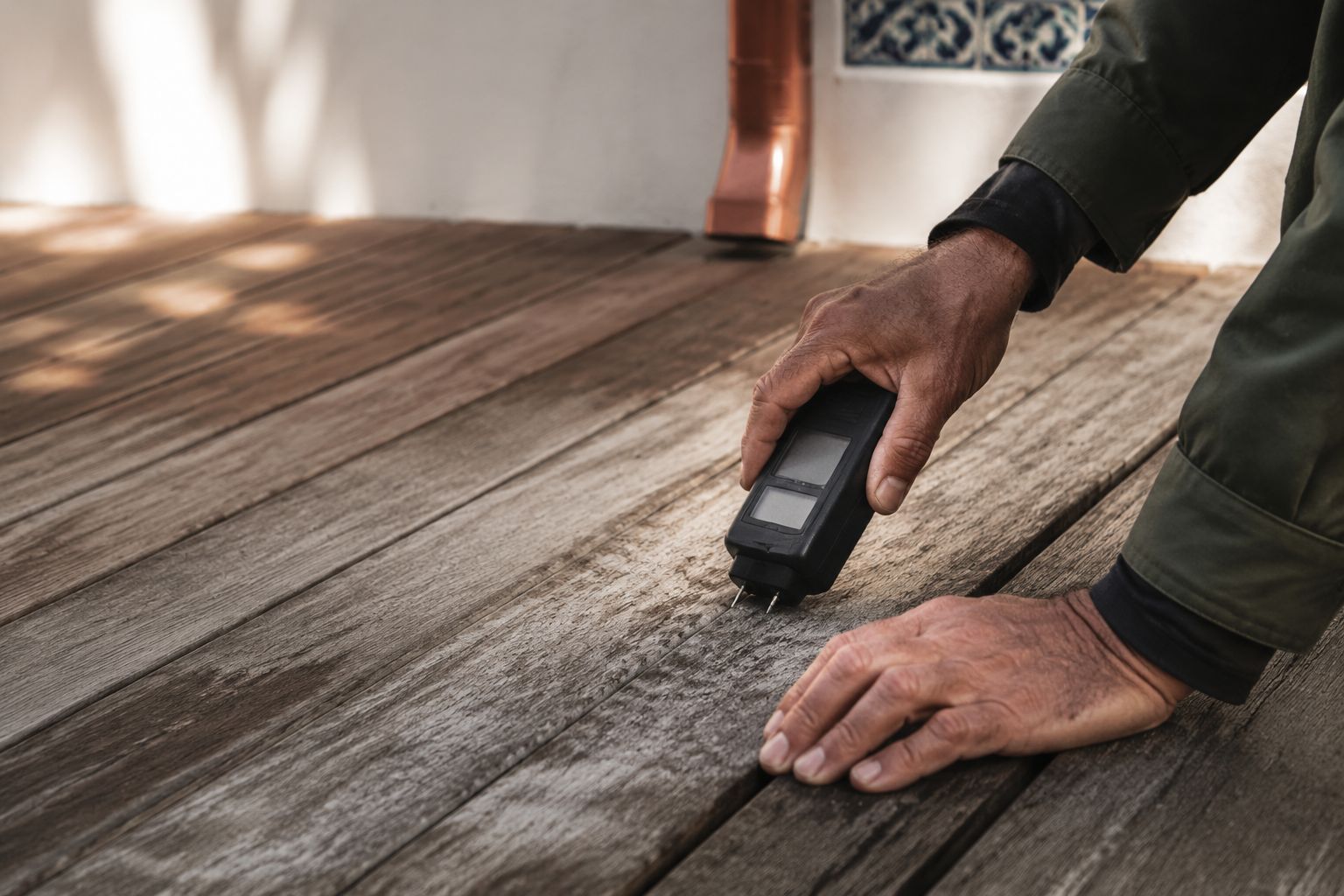
- Applying a finish to timber that is too damp. Follow the moisture limit and application conditions in the technical data sheet.
- Ignoring the fixings. Coastal exposure calls for appropriate fixings and checks on their condition, including less visible areas.
What a photograph cannot establish
It can show the general appearance and sometimes raised fibres. It cannot verify timber firmness or the condition of components beneath the boards, such as beams, supports and fixings. A deck may look well kept while having a compromised support.
Photographs can help frame an enquiry around cleaning or surface preparation. Decisions on repairs and replacement require an on-site check. Avoid using any section that appears unstable while awaiting assessment.
What affects the price?
- Type of work. Cleaning, sanding and replacement have different scopes.
- Area. A minimum charge may apply to small sections.
- Repairs. Specify the number of affected boards and condition of the supports.
- Timber species and finish. These influence preparation and suitable product quantities.
- Access. A raised deck or difficult route requires particular organisation.
Ask for cleaning, preparation, finishing and repairs to be distinguished. This lets you compare equivalent services without treating a simple wash as complete restoration.
Further reading
Check the material and finish instructions. These references support an assessment of timber but do not replace an inspection.
Frequently asked questions
Does grey decking always need sanding?
No. Grey colour alone does not determine the work. First examine the timber and existing finish. Cleaning and, where appropriate, a compatible wood brightener may be enough. Sanding is used when the surface preparation requires it before a suitable finish.
Can I clean the deck myself before deciding?
You can start by removing debris and testing gentle brushing along the grain, using a compatible cleaner if needed. Avoid aggressive jets. If boards are soft, broken or unstable, stop using that area and ask for an on-site assessment.
Clarify the work your deck needs
Send an overview and close-ups of the boards, together with the known finish and locality in Portugal. Puro Terraço can provide initial guidance on cleaning and preparation. Repairs and replacements need confirmation on site.
Explore our timber deck restoration service and exterior wood treatment information (page in Portuguese).
Further reading